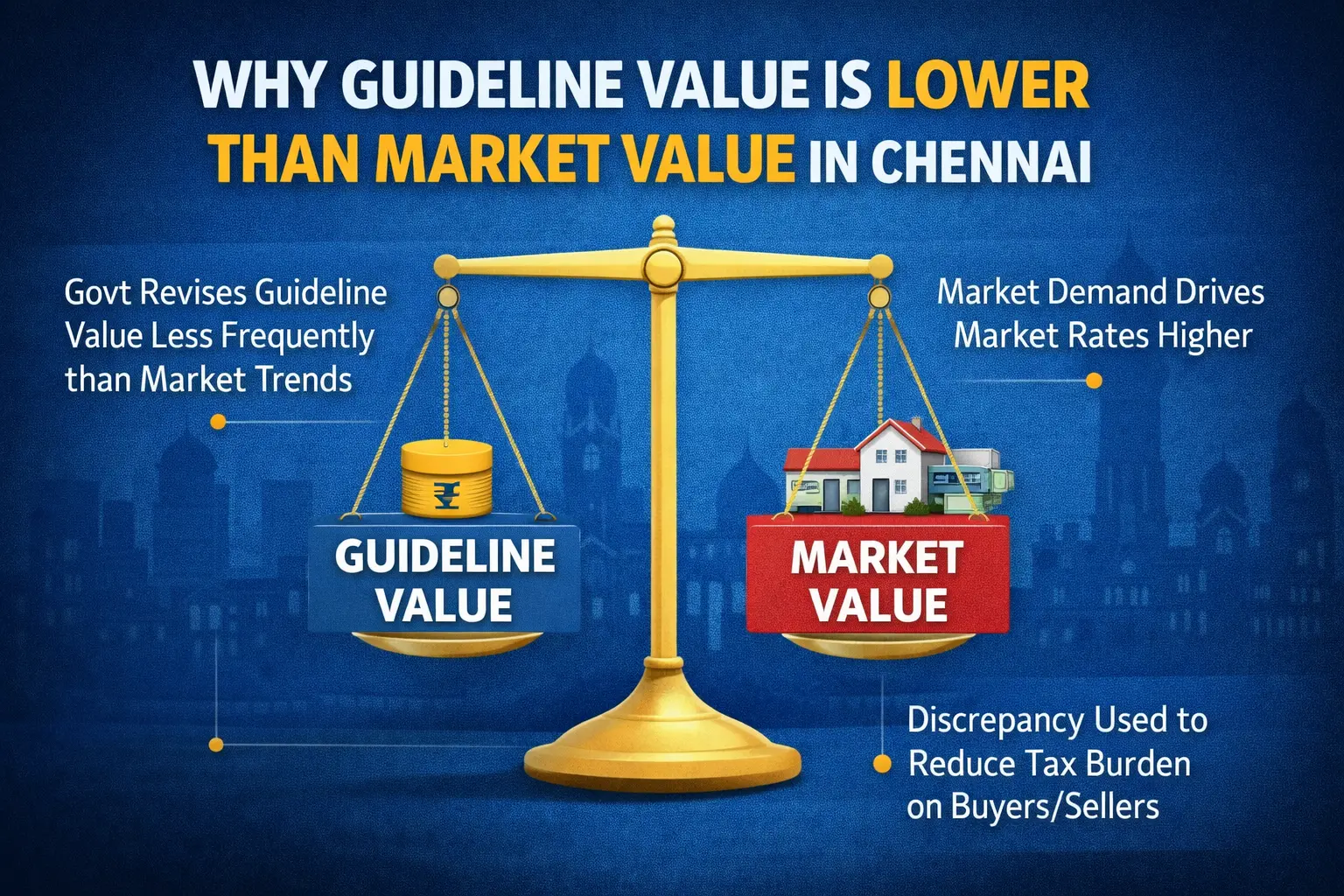
In Chennai, the difference between Guideline Value (GV) and Market Value (MV) is systemic, intentional, and policy-driven. It is not an error, delay, or inefficiency. The two values serve different purposes, are calculated using different methods, and are meant for different stakeholders.
1. Fundamental Difference Between Guideline Value and Market Value
1.1 Guideline Value: A Legal & Administrative Tool
Guideline Value is a statutory benchmark fixed by the government to:
- Ensure a minimum tax base
- Prevent deliberate undervaluation
- Maintain uniformity across registrations
It is not a price indicator and not meant to reflect true demand.
1.2 Market Value: An Economic Reality
Market value represents the following:
- What a buyer is willing to pay
- What a seller is willing to accept
It responds instantly to:
- Infrastructure announcements
- Job growth
- Investor sentiment
- Future expectations
2. How Guideline Value Is Fixed in Tamil Nadu (Step-by-Step)
2.1 Data Sources Used
The government relies on:
- Past registered sale deeds
- Average land rates by zone
- Road classification (main road / side road)
- Usage type (residential / commercial)
2.2 What Is Intentionally Ignored
- Recent speculative price spikes
- Builder premiums
- Interior quality
- Amenities
- Demand from specific buyer groups
This is deliberate because:
- These factors fluctuate too fast
- They are difficult to defend legally
- They differ property to property
Hence, GV is designed to be:
- Defensible
- Conservative
- Stable
3. Why Market Value Always Runs Ahead in Chennai
3.1 Chennai’s Demand Grows Faster Than Policy Updates
Chennai’s growth drivers:
- IT & SaaS sector
- Port-based industries
- Metro Rail expansion
- Suburban connectivity
Market prices respond immediately.
GV revisions take years.
This time lag alone creates a permanent gap.
3.2 Micro-Market Complexity
In Chennai:
- One end of a road may be flood-prone
- Another end may be elevated
- One plot may face a park
- Another faces a drain
Market prices reflect these nuances.
Guideline value cannot.
3.3 Infrastructure Value Is Forward-Looking
Market value includes:
- “Future appreciation”
- “Upcoming metro station”
- “Planned commercial hub”
Guideline value includes:
- Only existing, proven data
This makes GV reactive, while MV is predictive.
4. Government’s Intentional Under-Alignment Strategy
4.1 Preventing Transaction Collapse
If GV = MV:
- Stamp duty jumps instantly
- Buyers delay purchases
- Registration volumes fall
- Government revenue drops
So the state maintains:
Lower GV = Higher compliance + steady revenue
4.2 Social & Political Sensitivity
Property purchases involve:
- Life savings
- Retirements
- Inherited assets
A sharp GV hike:
- Triggers public opposition
- Creates affordability stress
Hence, revisions are gradual and controlled.
4.3 Revenue Stability Over Maximum Revenue
The government prioritizes:
- Predictable inflows
- Long-term collections
Not:
One-time windfalls from higher duty
5. Chennai-Specific Factors That Widen the Gap
5.1 Rapid Peripheral Development
Areas such as:
- OMR belt
- Medavakkam
- Perumbakkam
- Pallikaranai
Experience:
- Sudden demand surges
- Faster price appreciation
GV lags behind these shifts significantly.
5.2 Flood Risk Pricing
Market discounts flood-prone areas heavily.
GV does not adjust dynamically.
This creates:
- Overvaluation in risky areas
- Undervaluation in safer micro-zones
5.3 Builder-Led Price Inflation
Premium builders command:
- Trust premium
- Quality premium
- Lifestyle premium
GV only sees:
Land category + structure type
6. Legal & Financial Consequences of the Gap
6.1 Stamp Duty Calculation
Stamp duty = % of higher of GV or declared price
Lower GV:
- Reduces minimum tax liability
- Keeps transactions affordable
6.2 Capital Gains Tax Impact
Lower registered purchase value →
Higher taxable gains on resale.
This is one of the hidden long-term costs.
6.3 Home Loan Implications
Banks consider:
- Registered value
- Independent valuation
A wide GV-MV gap may:
- Reduce loan eligibility
- Increase down payment requirement
7. Why GV Will Never Equal Market Value
- Market value is volatile
- GV must be legally defensible
- Alignment causes tax shock
- Stability is prioritized over precision
Therefore:
A permanent GV–MV gap is policy-intentional
8. Can Guideline Value Ever Be Higher Than Market Value?
Yes, but rarely, in:
- Declining neighborhoods
- Over-supplied markets
- Areas with infrastructure decay
9. Should Buyers or Sellers Worry About This Gap?
No—if understood correctly.
GV is for:
- Tax compliance
MV is for:
- Pricing
- Negotiation
- Investment decisions
FAQs
1. Why can’t guideline value reflect actual prices?
Because actual prices are:
- Subjective
- Negotiated
- Emotion-driven
The government needs objective benchmarks.
2. Does higher GV always mean higher property prices?
No. GV does not influence demand.
3. Can GV be revised for a single street or plot?
No. It applies only at zonal level.
4. Does GV affect rental income?
No. Rental value is market-driven.
5. Why do luxury properties show huge gaps?
Because GV ignores:
- Brand value
- Amenities
- Lifestyle premium
6. Can GV be used for property valuation?
No. It is not a valuation tool.
7. Is GV manipulation possible?
Not individually. It is government-controlled.
8. Will digital registration reduce the gap?
It reduces cash dealings, not the policy gap.
9. Is GV different for land vs apartments?
Yes. Apartments include UDS + construction cost.
10. Should investors track GV changes?
Yes—but only to estimate transaction cost impact, not ROI.