1. Meaning of Undervaluation
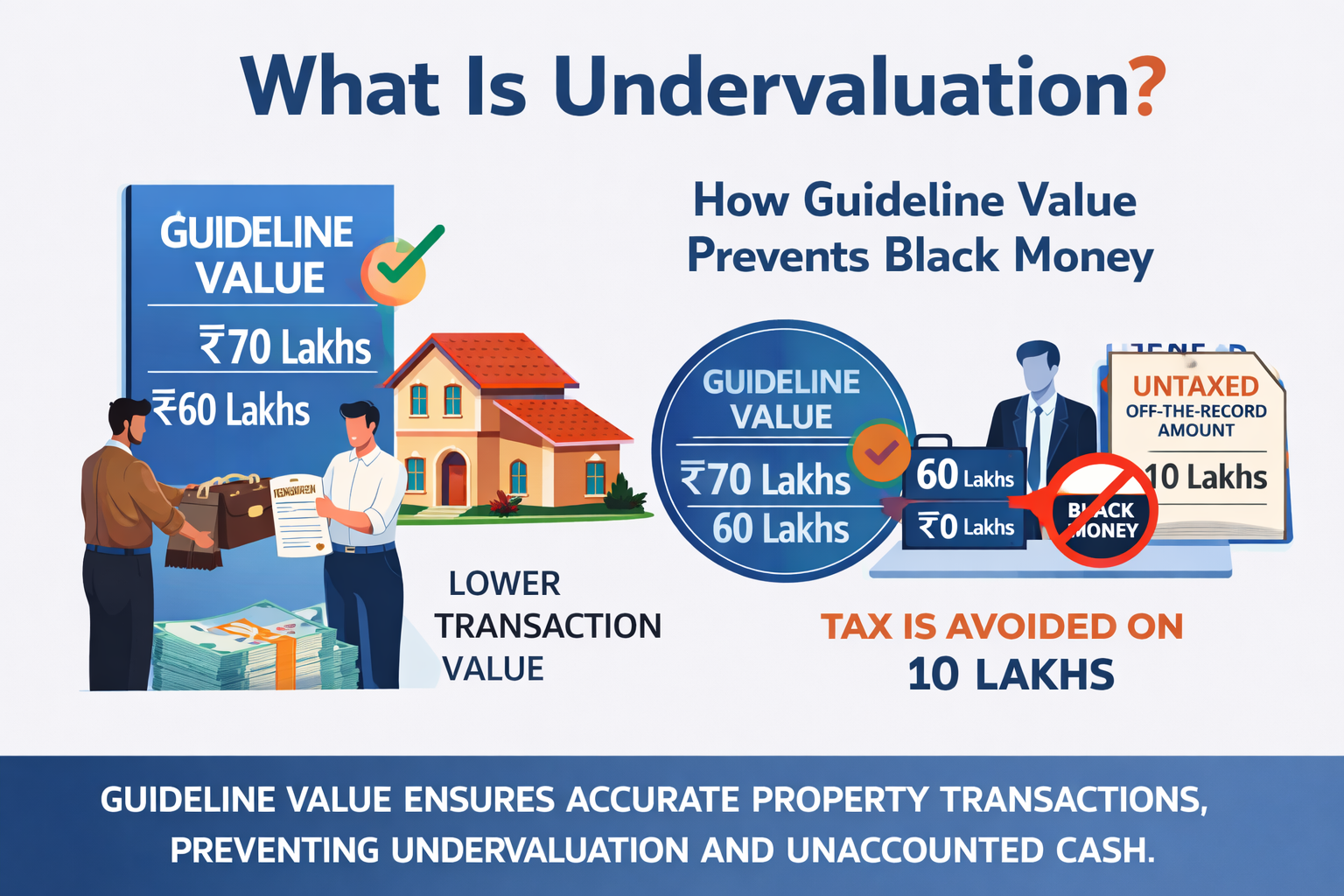
Undervaluation refers to the practice of declaring a property’s value lower than its actual market price in official sale documents at the time of registration. Although the buyer may pay the real price, only a reduced amount is shown on paper, and the remaining amount is often paid in cash, which becomes black money.
2. How Undervaluation Happens (Step-by-Step)
- Buyer and seller agree on the actual price
- They decide to show a lower value in registration documents
- Stamp duty and registration charges are paid on the lower value
- The remaining amount is paid outside the banking system
- This unreported amount is not taxed
3. Example of Undervaluation
- Actual market value of property: Rs 80 lakhs
- Value shown in registration: Rs 60 lakhs
- Difference paid in cash: Rs 20 lakhs
Impact:
- Stamp duty paid only on Rs 60 lakhs
- Tax avoided on Rs 20 lakhs
- Rs 20 lakhs becomes black money
4. Why Undervaluation Is a Serious Problem
A. Growth of Black Money
Unaccounted cash enters the economy, weakening financial transparency.
B. Loss to Government
The government loses revenue from:
- Stamp duty
- Registration fees
- Income tax
- Capital gains tax
C. Artificial Property Prices
Undervaluation distorts real estate pricing and misleads buyers.
D. Legal Risk
- Both buyer and seller face:
- Income tax notices
- Heavy penalties
- Prosecution in serious cases
5. What Is Black Money in Real Estate?
Black money is income that:
- Is not declared to tax authorities
- Is not recorded in official accounts
- Is often generated through cash transactions
Real estate is one of the largest contributors to black money due to high-value deals and cash components.
6. What Is Guideline Value?
Guideline Value (also called Circle Rate / Ready Reckoner Rate) is the minimum value fixed by the state government for property registration in a particular area. It represents the lowest legally acceptable value at which a property can be registered.
7. How Guideline Value Is Determined
State governments determine guideline value based on:
- Location and infrastructure
- Past registered transactions
- Property type (land, apartment, commercial)
- Road access and development
- Market trends
8. Legal Rule Related to Guideline Value
Stamp duty and registration charges must be paid on whichever is higher:
- Actual sale price
- Guideline value
This rule ensures that undervaluation is restricted.
9. How Guideline Value Prevents Black Money (Detailed Explanation)
1. Fixes a Minimum Registration Value
Properties cannot be registered below the guideline value, making it difficult to show artificially low prices.
2. Discourages Cash Transactions
Since registration reflects higher values, buyers and sellers are forced to route money through banking channels.
3. Enables Tax Monitoring
Tax authorities compare:
- Sale deed value
- Guideline value
- Market data
Any mismatch triggers scrutiny.
4. Protects Buyers
Buyers are safeguarded from future tax notices and legal disputes.
5. Reduces Tax Evasion
Higher declared values mean:
- Proper stamp duty payment
- Correct capital gains tax
- Fair income disclosure
10. Income Tax Provisions Related to Undervaluation
For Buyers
If purchase price is significantly lower than guideline value:
- The difference may be taxed as income from other sources
For Sellers
If sale price is undervalued:
- Capital gains may be calculated based on guideline value instead of sale price
11. Advantages of Guideline Value System
- Prevents tax evasion
- Promotes transparency
- Protects honest buyers
- Ensures fair government revenue
- Strengthens formal economy
12. Limitations of Guideline Value
- Sometimes lower than market value
- Revision may be delayed
- May not reflect micro-market conditions
Despite limitations, it remains a powerful control mechanism.
13. Role of Banks and Financial Institutions
Banks use guideline value to:
- Decide loan eligibility
- Avoid inflated valuations
- Ensure legal compliance
14. Long-Term Impact on Economy
- Reduced black money circulation
- Higher tax compliance
- Stable real estate prices
- Stronger financial system
15. Conclusion
Undervaluation is a major source of black money and tax evasion in real estate.
Guideline value acts as a legal checkpoint, ensuring transparency, accountability, and fair taxation.
By enforcing minimum registration values, the government:
- Limits cash transactions
- Protects buyers and sellers
- Strengthens the economy
FAQs
1. Is undervaluation a criminal offense?
Yes, deliberate undervaluation to evade tax is illegal.
2. Can property value be less than guideline value?
No, registration is not allowed below guideline value.
3. Does guideline value eliminate black money fully?
No, but it significantly reduces it.
4. Who sets the guideline value?
State governments through registration departments.
5. Is the guideline value the same across India?
No, it varies by state, city, and locality.