Understanding TNRERA
Tamil Nadu Real Estate Regulatory Authority (TNRERA) is the statutory authority established under the Real Estate (Regulation and Development) Act, 2016. It governs real estate projects in Tamil Nadu, including Chennai, to ensure transparency, accountability, and buyer protection. Any eligible residential or mixed-use project must be registered with TNRERA before it is advertised, booked, or sold.
Why TNRERA Is Critical for Chennai Flat Buyers
Before TNRERA, buyers had limited legal protection and often depended only on builder promises. Under TNRERA:
- Builders are legally bound to declared timelines and specifications
- Project details are publicly available
- Buyer money is regulated and monitored
- Buyers have a formal dispute-resolution mechanism
This makes TNRERA verification non-negotiable before signing any agreement.
Projects That Must Be Registered Under TNRERA
A Chennai flat buyer must confirm registration if the project has the following:
- Land area above 500 sq. metres, or
- More than 8 residential units, or
- Multiple phases (each phase must be registered separately)
Unregistered projects under these criteria cannot legally be sold.
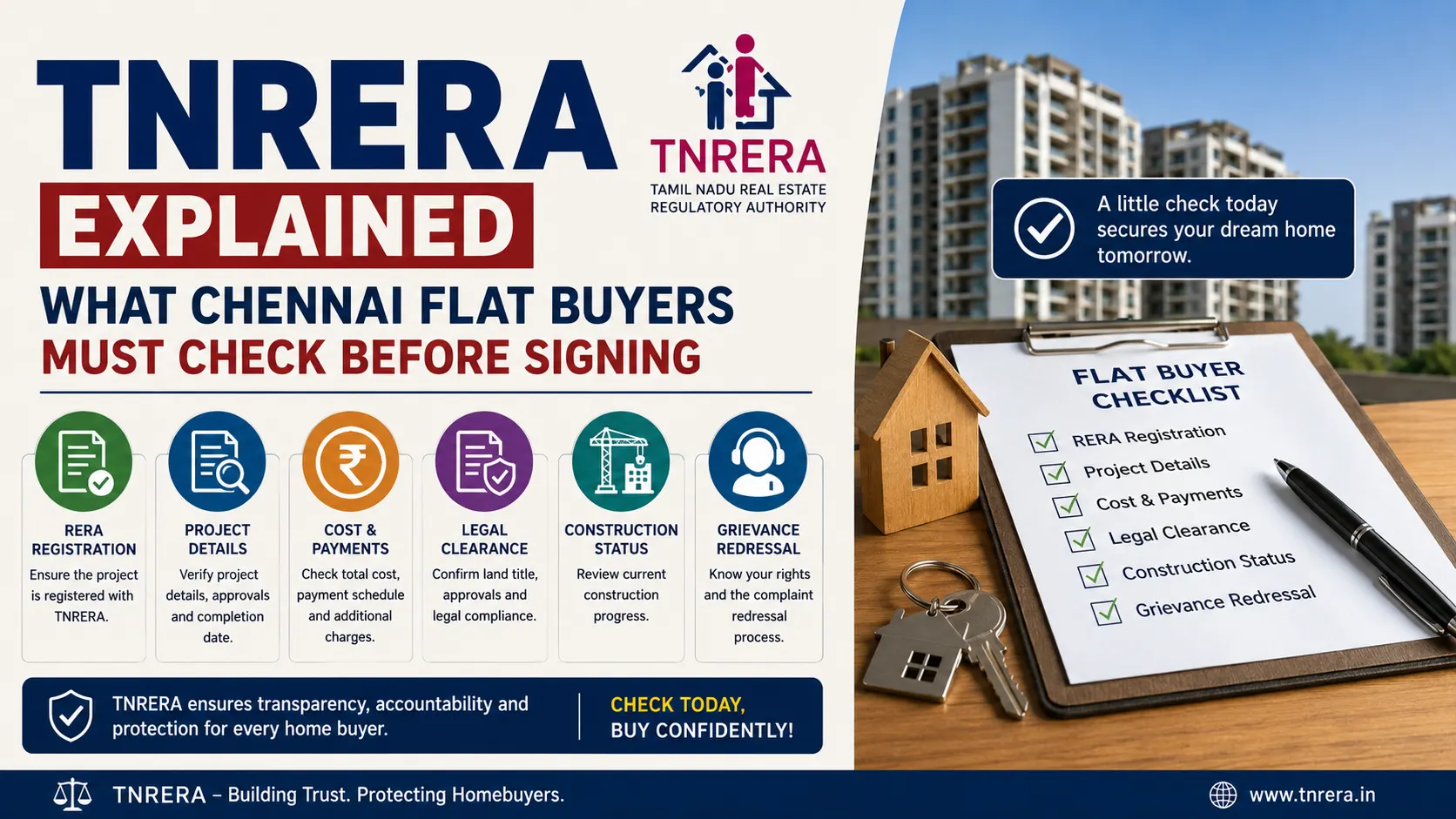
What Chennai Flat Buyers Must Check Before Signing
1. TNRERA Registration Status
- The project must have a valid and active TNRERA registration number
- The project name, promoter name, and location must exactly match what the builder advertises
- Registration status should not be expired, revoked, or under litigation
If a project is not registered, buyers lose RERA protection.
2. Approved Layout and Building Plans
Buyers must compare:
- Approved layout plans uploaded on TNRERA
- Floor plans, flat sizes, and number of units
- Common amenities and open spaces
Any difference between approved plans and brochures is a serious red flag. Builders cannot legally change plans without buyer consent and regulatory approval.
3. Carpet Area Disclosure
Under TNRERA:
- Flats must be sold only on carpeted areas.
- Super built-up or vague area calculations are not allowed
The carpet area is mentioned in:
- TNRERA records
- Agreement for Sale
- must be identical.
4. Possession Date and Project Timeline
TNRERA mandates that builders declare the following:
- Exact possession date
- Construction milestones
- Phase-wise completion schedule
If possession is delayed beyond the registered date, buyers are entitled to compensation or interest as per law.
5. Construction Progress Updates
Builders must upload quarterly progress reports, including:
- Stage of construction
- Photographs
- Approvals status
Missing or outdated updates indicate possible financial or execution issues.
6. Promoter (Builder) Credentials
Buyers should verify:
- Promoter registration with TNRERA
- Past and ongoing projects
- History of delays, complaints, or penalties
A builder with repeated violations signals high risk.
7. Fund Utilisation and Escrow Compliance
TNRERA requires:
- Buyer payments to be deposited in regulated project accounts
- Funds to be used only for land and construction of the same project
This prevents diversion of funds to other projects, a common cause of delays earlier.
8. Agreement for Sale (Mandatory RERA Format)
Before signing:
- Agreement must follow the RERA-prescribed format
- One-sided clauses favouring the builder are not allowed
- Penalty clauses must apply equally to buyer and builder
9. Legal Title and Land Ownership
Although TNRERA is not a title-verification authority, buyers must still ensure:
- Clear land title
- Proper development rights
- No conflicting ownership claims
10. Complaint and Grievance History
Buyers should check:
- Pending complaints against the project
- Orders passed by TNRERA against the promoter
Major Red Flags for Chennai Flat Buyers
- No TNRERA registration number
- Different possession dates verbally promised vs RERA portal
- Mismatch in flat size or amenities
- Pressure to sign or pay before verification
- Claims that RERA “does not apply”
Any of these should stop the transaction immediately.
Legal Rights of Buyers Under TNRERA
Chennai flat buyers are legally entitled to:
- Timely possession
- Compensation for delays
- Refund with interest in case of cancellation
- Rectification of structural defects
- Filing complaints directly with the authority
- Orders passed by TNRERA are legally enforceable.
Conclusion
TNRERA is the strongest legal shield available to Chennai flat buyers. Verifying registration, approvals, timelines, and builder disclosures before signing ensures transparency, protects your investment, and prevents long-term legal and financial stress. Ignoring TNRERA checks can result in loss of money, delayed possession, or legal disputes that last years.