1. “Edge-of-Hub” Advantage (Not Inside the Pressure Zone)
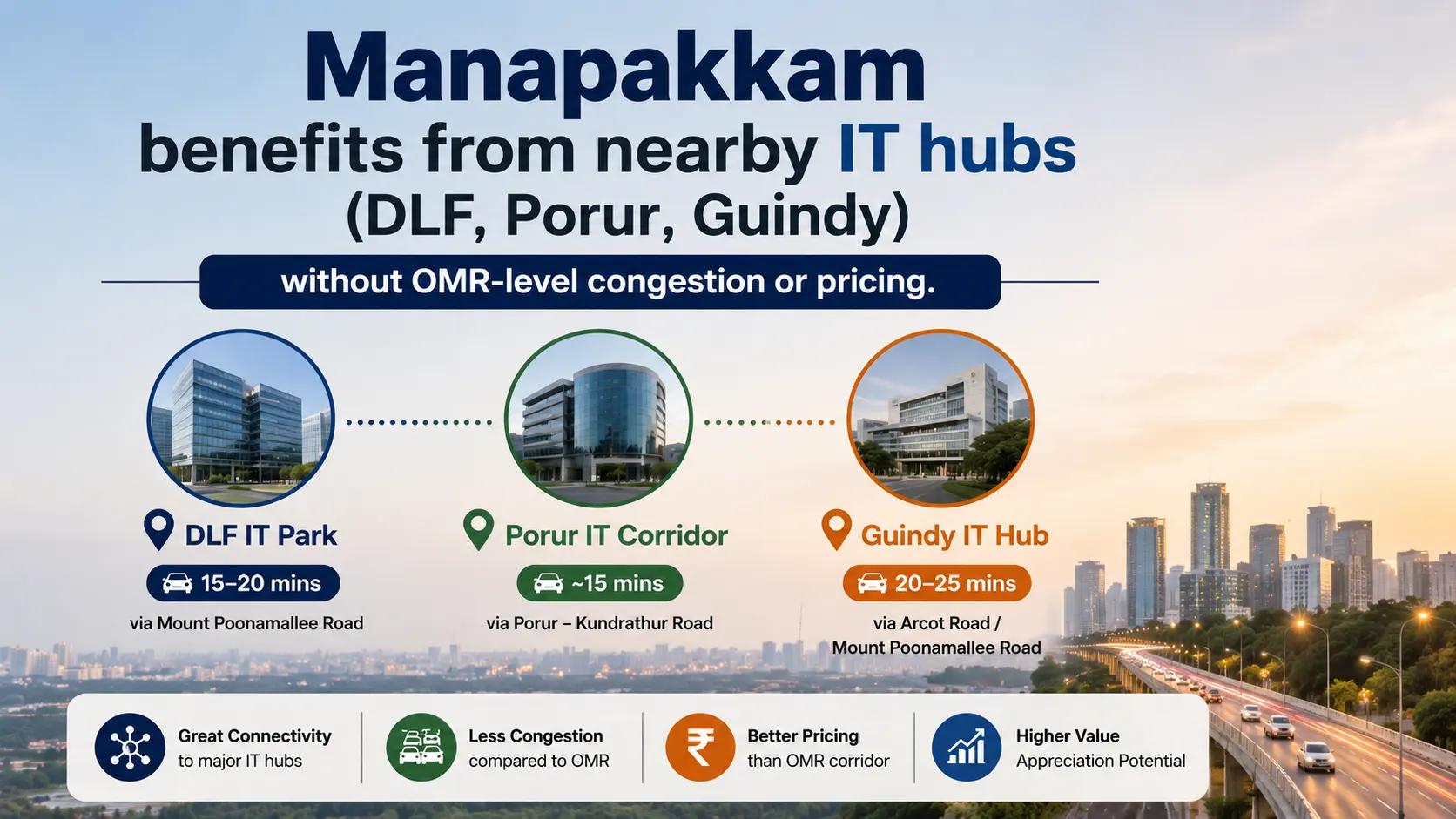
Manapakkam functions as an edge residential zone to multiple IT hubs rather than being embedded in one.
In IT corridors like OMR:
- Residential and office traffic peak at the same time
- One road failure affects the entire corridor
- Housing supply is built assuming future demand
In Manapakkam:
- Commutes are spread across Porur, Guindy, Mount Road directions
- No single employer or road dominates demand
- Residential life is not subordinated to office activity
Result: Lower congestion stress and more predictable daily routines.
2. Demand Quality Is Higher Than Demand Volume
OMR attracts large volumes of entry- and mid-level IT professionals, which creates:
- High rental churn
- Price sensitivity
- Investor-heavy buying
Manapakkam attracts:
- Mid-senior professionals working in DLF, Porur, and Guindy
- Corporate lease tenants
- Families planning long stays
Result: Fewer transactions, but stronger holding power.
3. Why Pricing Stays Rational (and Likely Will)
OMR pricing often includes:
- “Future metro” premiums
- Speculative infrastructure assumptions
- High-rise density expectations
Manapakkam's pricing reflects the following:
- Present-day usability
- Livability and space
- Actual commute efficiency
Key insight:
Manapakkam doesn’t need future stories to justify prices—this keeps valuations grounded and reduces downside risk.
4. Traffic Isn’t Absent — It’s Distributed
Manapakkam is not traffic-free, but it avoids concentrated choke points.
OMR pain:
- One corridor = one failure point
- Office hours amplify congestion
Manapakkam reality:
- Multiple entry/exit routes (Porur, Ramapuram, Mount Road side)
- Traffic spreads across directions
- Peak congestion windows are shorter
Result: Stress reduction, even if distance is similar.
5. Livability Compounds Value Over Time
As buyers age and family needs change:
- Noise tolerance drops
- Preference shifts from “close to office” to “easy life”
OMR often loses older residents to central or west Chennai. Manapakkam retains residents longer.
Long-term insight:
Areas with high resident retention show better resale liquidity, even if price growth is slower.
6. Supply Discipline Protects Capital
Manapakkam’s constraints:
- Smaller land parcels
- Fewer mega projects
- Redevelopment over expansion
OMR’s reality:
- Continuous supply pipelines
- Price caps due to competition
Result: Manapakkam behaves like a capital-preservation market, not a speculation market.
7. What This Means in a Down Cycle
When IT hiring slows:
- OMR sees rent pressure and longer vacancies
- Investor-led markets react first
Manapakkam:
- Holds demand due to diversified employment access
- Sees fewer forced sellers
Insight:
Downside protection is as important as upside—and this is where Manapakkam quietly outperforms.
Conclusion
- Manapakkam doesn’t try to be an IT corridor.
- It benefits from IT without being consumed by it.
That balance—between access and insulation—is what makes Manapakkam a quietly strong residential micro-market in Chennai.