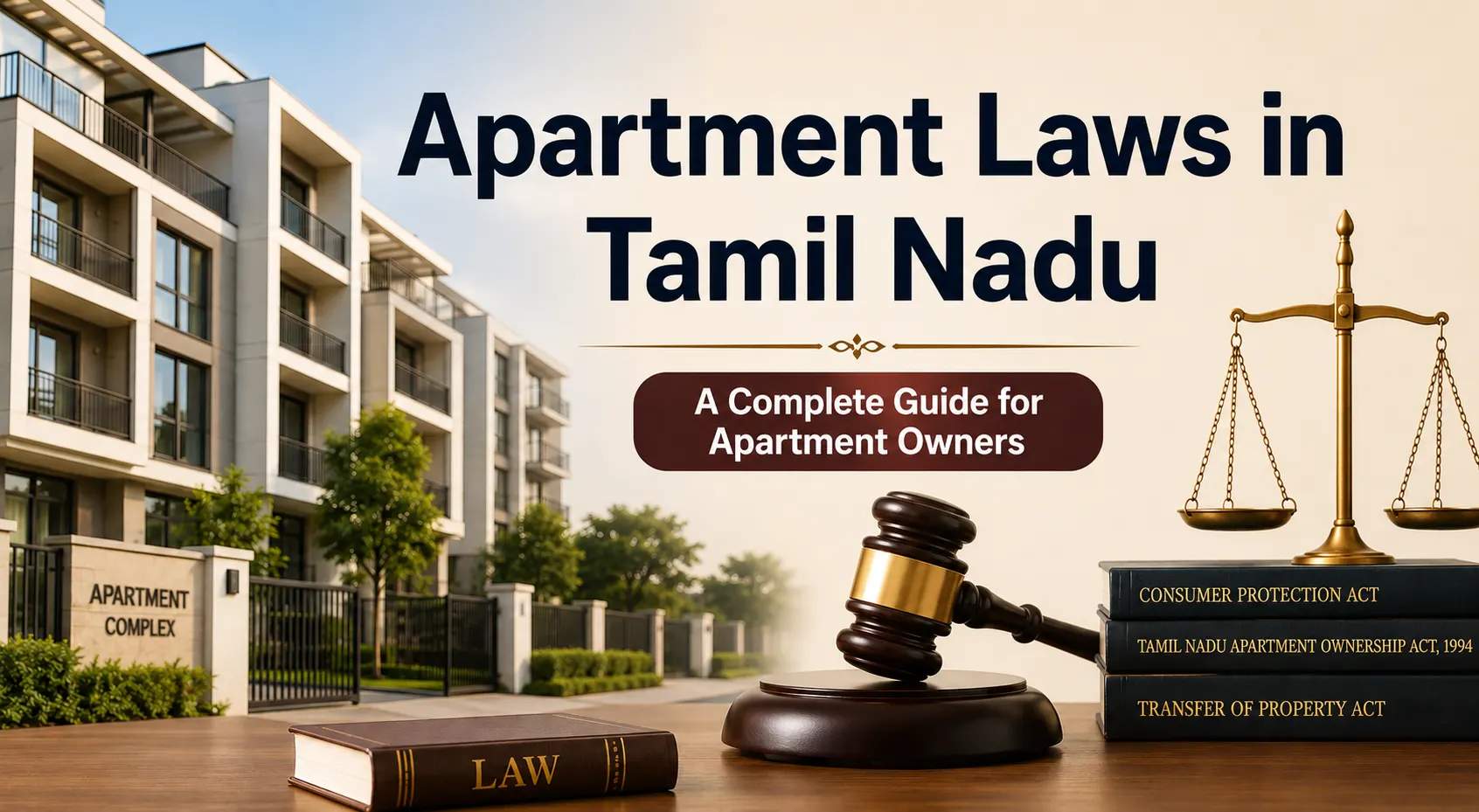
Apartment ownership and management in Tamil Nadu is governed by a specific statutory framework that defines the rights of apartment owners, obligations of builders, formation of associations, and management of common areas. The law ensures clarity of ownership, peaceful enjoyment of property, and collective administration of apartment buildings.
1. Governing Law in Tamil Nadu
The primary law governing apartments in the state is the Tamil Nadu Apartment Ownership Act, 2022.
This Act repealed and replaced the earlier 1994 law and was enacted to:
- Recognize apartments as independent immovable property
- Provide legal backing for apartment owner associations
- Define ownership of common areas
- Regulate rights, duties, and liabilities of apartment owners
The Act is supported by the Tamil Nadu Apartment Ownership Rules, 2024, which prescribe procedures, forms, and operational details.
2. Applicability of the Act
The Act applies to:
- Buildings containing four or more apartments
- Residential, commercial, or mixed-use apartment buildings
- Both newly constructed and existing apartment complexes (once submitted under the Act)
It does not automatically apply unless the promoter or apartment owners submit the property to the Act by executing and registering a Deed of Apartment.
3. Meaning of an Apartment
An apartment is defined as:
- A separate and self-contained unit
- Used for residential or non-residential purposes
- Located on one or more floors
- Having independent access through common areas
Each apartment is treated as a distinct property, capable of being owned, sold, mortgaged, or inherited independently.
4. Apartment Owner – Legal Status
An apartment owner is a person who:
- Owns an apartment and its undivided share in common areas
- Includes heirs, legal representatives, and transferees
- May include long-term lessees (as defined by law)
Apartment ownership automatically includes undivided interest in common areas, which cannot be separated or sold independently.
5. Common Areas and Facilities
Common areas include:
- Land on which the building stands
- Foundations, columns, beams, roofs, corridors
- Staircases, lifts, lobbies, fire escapes
- Basements, parking areas (if declared common)
- Water tanks, pumps, generators
- Electrical, plumbing, sewage systems
- Community halls, gardens, play areas (if declared common)
Legal nature:
- Common areas are jointly owned
- Each owner’s share is proportional to their apartment’s value or area
- No owner can claim exclusive ownership over common areas unless specifically declared as limited common areas
6. Undivided Share (UDS)
Each apartment owner holds an undivided share in:
- The land
- Common areas and facilities
Key points:
- UDS is inseparable from the apartment
- It automatically transfers with sale or inheritance
- It cannot be sold, gifted, or mortgaged independently
7. Deed of Apartment
The Deed of Apartment is the foundational legal document under the Act.
It contains:
- Description of the land
- Description of the building
- Details of each apartment
- Percentage of undivided share
- Common areas and facilities
- Limited common areas (if any)
Once registered, this deed:
- Converts apartments into independent properties
- Makes the Act applicable to the building
- Binds all apartment owners legally
8. Apartment Owners Association
Formation
Apartment owners must form an Association of Apartment Owners after registration of apartments.
Legal status
- The association becomes a body corporate
- It can sue and be sued
- It can own property, open bank accounts, and enter contracts
Functions
- Maintenance of common areas
- Collection of maintenance charges
- Enforcement of bye-laws
- Management of staff and service providers
- Insurance of the building
- Handling disputes among members
9. Bye-laws of the Association
Bye-laws are binding rules governing internal management.
They generally cover:
- Membership rules
- Voting rights
- General body meetings
- Election of office bearers
- Maintenance contribution formula
- Use of common areas
- Penalties for violations
All apartment owners are legally bound to comply with the bye-laws.
10. Rights of Apartment Owners
Apartment owners have the right to:
- Exclusive possession of their apartment
- Use common areas without obstruction
- Participate in association meetings
- Vote on matters affecting the building
- Inspect association accounts and records
- Sell, lease, mortgage, or inherit their apartment
11. Duties and Obligations of Apartment Owners
Every apartment owner must:
- Pay maintenance charges and dues on time
- Use the apartment as per approved purpose
- Not cause nuisance or structural damage
- Allow access for repairs of common services
- Comply with the Act, Rules, and bye-laws
Non-payment of dues can result in legal recovery proceedings by the association.
12. Transfer, Sale, and Inheritance
Apartments are treated as immovable property.
They can be:
- Sold through registered sale deed
- Gifted or settled
- Mortgaged to banks
- Inherited through succession or will
The transferee automatically becomes a member of the association.
13. Alterations and Structural Changes
Apartment owners:
- Cannot alter structural parts
- Cannot encroach on common areas
- May make internal non-structural changes with association approval (if required)
Unauthorized alterations may attract penalties and restoration orders.
14. Dispute Resolution
Disputes may arise between:
- Apartment owners
- Owners and the association
- Association and builder (if applicable)
Such disputes are resolved through:
- Civil courts
- Statutory authorities
- Remedies provided under general property and contract laws
Frequently Asked Questions
Q1. Is apartment ownership legal without this Act?
Yes, but the Act provides clear ownership, enforceable rights, and legal recognition of associations.
Q2. Is registration of an apartment mandatory?
Yes. An apartment becomes legally independent only after registration of the Deed of Apartment.
Q3. Can a builder retain control after forming the association?
No. Once the association is formed, control must be transferred to apartment owners.
Q4. Can common areas be sold by the builder?
No. Common areas cannot be sold or transferred separately.
Q5. Is parking a common area?
Yes, unless specifically declared as a limited common area in the Deed of Apartment.
Q6. Can an owner refuse to pay maintenance?
No. Maintenance payment is a statutory obligation.
Q7. Can an association disconnect water or electricity for non-payment?
Essential services generally cannot be disconnected, but legal recovery of dues is allowed.
Q8. Are bye-laws legally enforceable?
Yes. Bye-laws are binding on all apartment owners.
Q9. Can one owner block common areas?
No. Common areas must remain accessible to all owners.
Q10. Does undivided share reduce if new flats are added?
No, unless lawfully modified through consent and revised documentation.