The Real Estate (Regulation and Development) Act, 2016 (RERA), came into force on 1 May 2017 to correct long-standing problems in the Indian real estate sector. In Chennai, RERA brought major reforms to a market that earlier suffered from project delays, approval ambiguity, misleading advertisements, and weak buyer protection. In Tamil Nadu, RERA is implemented by the Tamil Nadu Real Estate Regulatory Authority (TNRERA). Understanding whether a flat is pre-RERA or post-RERA is critical before buying, investing, or even selling an apartment in Chennai.
1. What Is a Pre-RERA Apartment?
A Pre-RERA apartment is a residential project that:
- Was launched before 1 May 2017
- Was not required to register under RERA
- Could be completed or under construction at that time
Key Characteristics
- No compulsory project registration
- No fixed legal definition of carpet area
- Weak monitoring of approvals
- Builder-controlled timelines
- Buyer had limited legal remedies
Most apartments built in Chennai between 2000 and early 2017 are pre-RERA.
2. What Is a Post-RERA Apartment?
A Post-RERA apartment is a project that:
- Was launched on or after 1 May 2017
- Is mandatorily registered with TNRERA
- Must comply with strict disclosure, financial, and construction norms
Today, all new apartment projects in Chennai must be Post-RERA to be legally sold.
3. Legal Framework: How the Law Changed
Pre-RERA Scenario
- Real estate governed only by:
- Contract law
- Local planning laws
- Buyer–builder agreements heavily favoured builders
- No single authority for buyer complaints
Post-RERA Scenario
- RERA acts as a special law
- Overrides unfair contract clauses
- Creates a dedicated regulatory authority
- Ensures time-bound justice
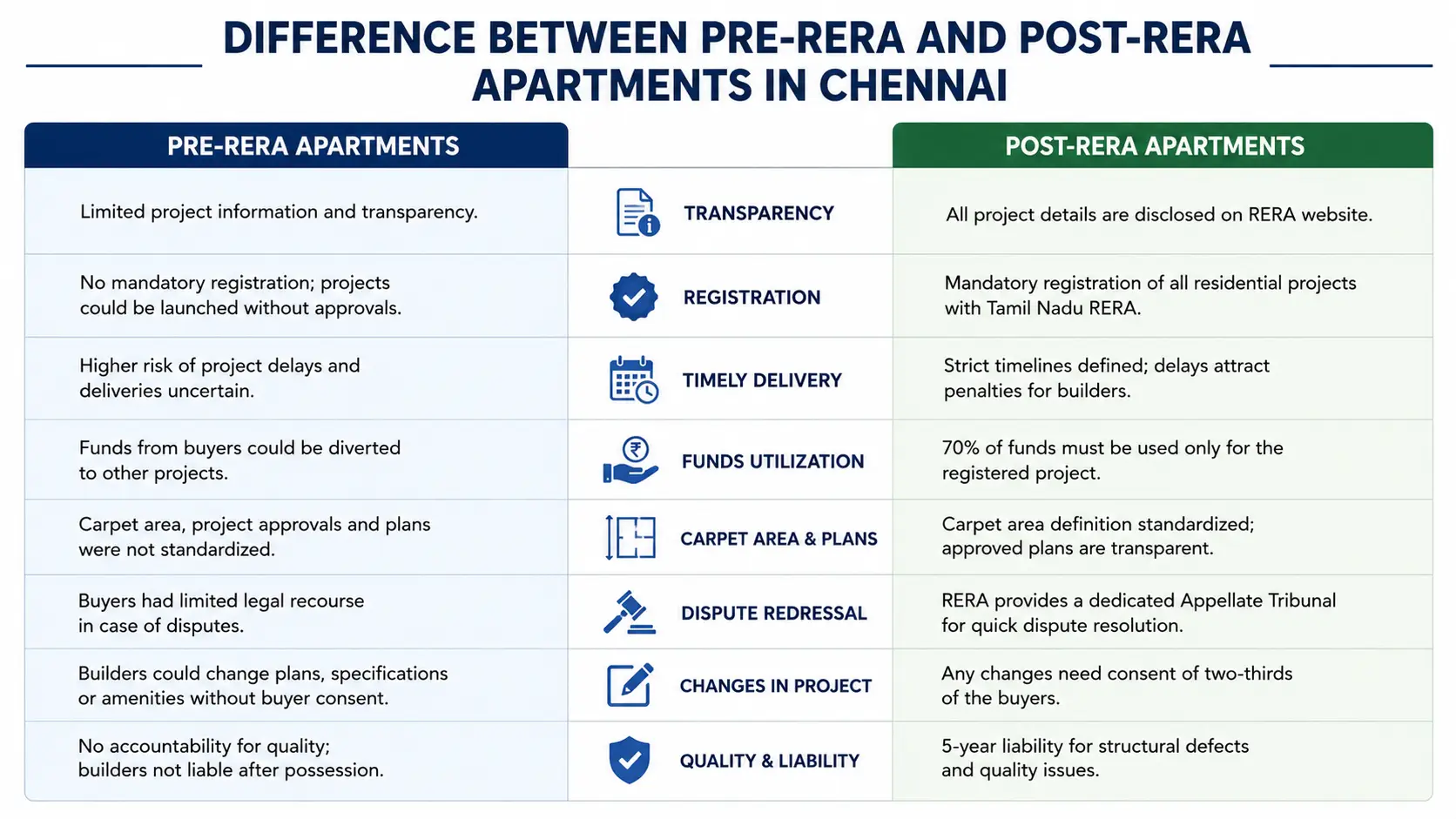
4. Approval Transparency & Documentation
Pre-RERA Apartments
- Builders showed partial approvals
- Changes in plan were common
- Buyers relied on brochures and verbal assurances
- CC / OC often delayed or missing
Post-RERA Apartments
Builders must upload on the RERA portal:
- Land ownership details
- CMDA / DTCP approvals
- Sanctioned plans
- Floor-wise schedule
- Completion timeline
- Litigation details (if any)
Buyers can verify everything online before booking.
5. Project Registration & Monitoring
Pre-RERA
- No public project database
- Buyers could not track:
- Construction progress
- Fund utilisation
- Completion certainty
Post-RERA
- Each project has a unique RERA registration number
- Quarterly progress updates mandatory
- Construction delays are visible publicly
- False disclosures attract penalties
6. Carpet Area vs Built-Up / Super Built-Up Area
Pre-RERA
- Flats sold based on:
- Built-up area
- Super built-up area
- Common area loading was unclear
- Buyers often received 15–30% less usable area
Post-RERA
- Flats must be sold only on carpet area
- Carpet area has a legal definition
- No manipulation of area calculations
- Buyer knows exact usable space
7. Possession Date & Project Delays
Pre-RERA
- Possession dates were tentative
- Delays of 2–5 years were common
- Builder rarely compensated buyers
Post-RERA
- The possession date is legally binding
- Delay consequences:
- The buyer can exit and get full refund with interest
- Or stay and receive monthly interest compensation
8. Financial Discipline & Fund Usage
Pre-RERA
- The builder could divert funds freely
- Money collected from one project used elsewhere
- Led to stalled and abandoned projects
Post-RERA
- 70% of buyer collections must be kept in a separate escrow account
- Funds can be used only for that specific project
- Chartered accountant audits mandatory
9. Changes in Layout, Floors & Amenities
Pre-RERA
- Builders often:
- Added extra floors
- Reduced open space
- Changed amenities
- Buyer consent not required
Post-RERA
- Any major change needs:
- Consent of two-thirds of all allottees
- Unauthorized changes attract penalties and cancellation of registration
10. Construction Quality & Defect Liability
Pre-RERA
- No post-handover accountability
- Buyers bore repair costs
- Structural issues common in older buildings
Post-RERA
- 5-year defect liability
- Builder must rectify the following:
- Structural defects
- Poor workmanship
- Buyer can approach RERA if builder refuses
11. Buyer Protection & Complaint Mechanism
Pre-RERA
- Options:
- Civil court
- Consumer court
- Costly and time-consuming
Post-RERA
- Dedicated RERA authority
- Online complaint filing
- Faster dispute resolution
- Penalties, refunds, and interest enforceable
12. Impact on Home Loans & Resale
Pre-RERA Apartments
- Banks may:
- Reject loans
- Ask for extra legal scrutiny
- Buyers cautious in resale
- Lower liquidity in market
Post-RERA Apartments
- Higher lender confidence
- Faster loan approvals
- Better resale demand
- Higher trust among buyers
FAQs
Is RERA applicable to old apartments?
Only if the project was ongoing after May 2017 and registered later. Fully completed old projects usually fall outside RERA.
Can I file a RERA complaint for a Pre-RERA flat?
Generally no, unless the project was registered as an ongoing project under RERA.
Are Post-RERA apartments more expensive?
Slightly, due to compliance costs, but they offer much higher legal safety.
Which is better for first-time buyers?
Post-RERA apartments, without doubt.
Do post-RERA flats guarantee no problems?
No flat is risk-free, but Post-RERA minimizes legal and financial risks.
Can builders sell without RERA registration?
Illegal for projects launched after May 2017.
Which has better resale value in Chennai?
Post-RERA apartments have faster resale and better pricing confidence.