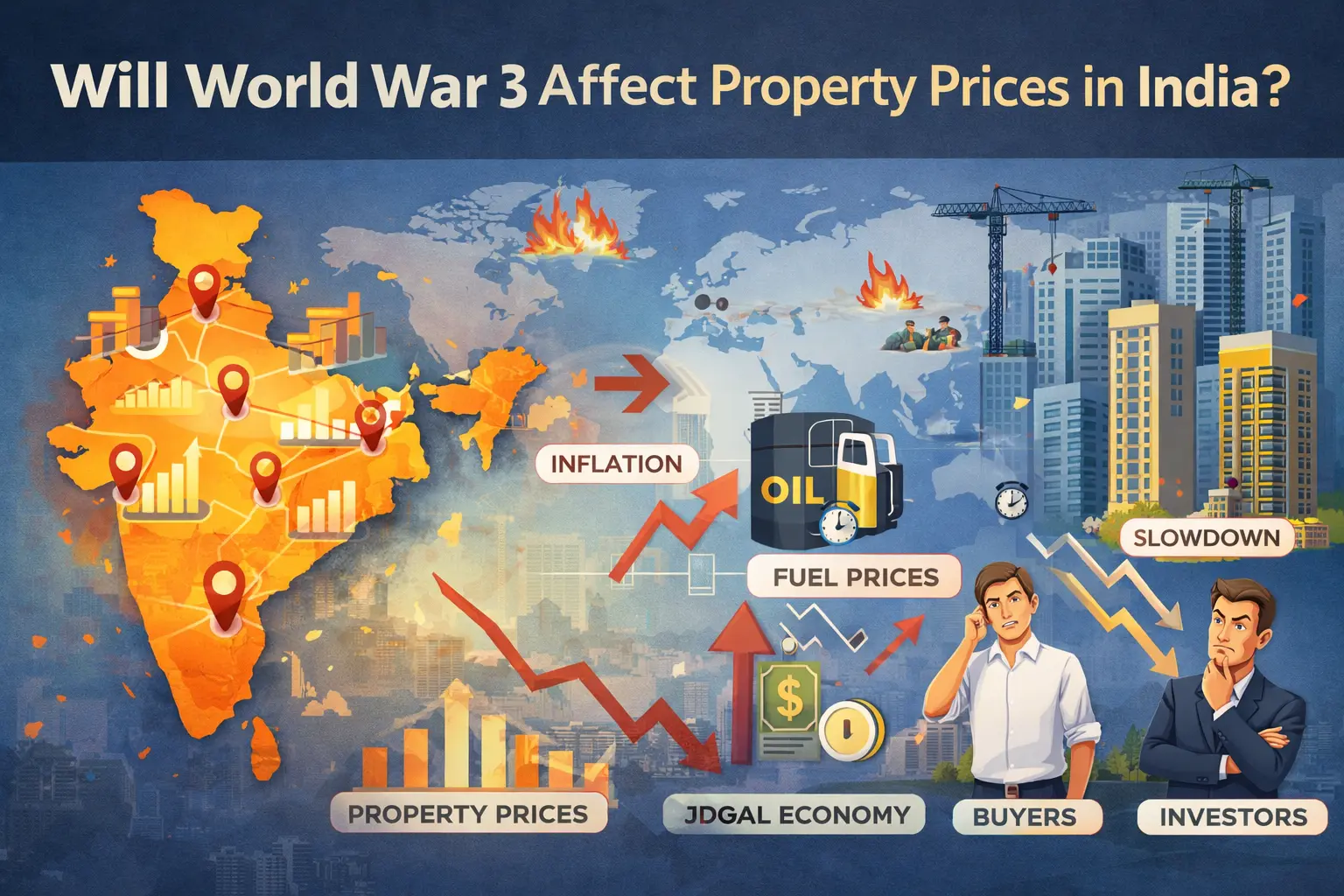
Will World War 3 Affect Property Prices in India?
A global conflict on the scale of World War 3 would have wide-ranging economic consequences across countries, markets, and industries. Real estate, being closely linked to economic stability, investor confidence, inflation, and employment, would inevitably feel the impact. In India, however, the effect would not be uniform and would depend heavily on the nature of the conflict, India’s involvement, and the global economic response.
Global Economic Shock and Its Transmission to India
Large-scale wars typically disrupt global trade, energy supplies, and financial markets. These disruptions raise commodity prices—especially oil and gas—leading to higher inflation worldwide. For India, which imports a significant portion of its energy needs, rising fuel costs would increase transportation, construction, and material expenses. Higher costs reduce developers’ margins and slow new project launches, indirectly affecting property prices. Global financial instability also leads to cautious capital movement. International investors often pull money from emerging markets during crises, which can reduce liquidity in India’s real estate sector, particularly in commercial and luxury segments that depend more on foreign investment.
Impact on Inflation, Interest Rates, and Home Loans
One of the most direct effects of a global war is inflation. As prices rise, central banks usually respond by increasing interest rates. In India, higher interest rates would make home loans more expensive, reducing affordability for buyers. This typically leads to slower sales, longer inventory cycles, and price stagnation rather than sharp price drops. For end-users, rising EMIs discourage new purchases, while investors may delay or exit short-term property investments. This slows overall demand, especially in price-sensitive markets.
Residential Real Estate: Stability with Slower Growth
India’s residential real estate market is largely driven by domestic demand—urbanization, population growth, and household formation. These structural factors provide a degree of insulation even during global crises.
In a World War 3 scenario where India is not directly involved:
- Prices may stop rising rapidly but are unlikely to collapse
- Demand for affordable and mid-income housing would remain relatively stable
- Buyers may adopt a “wait and watch” approach, reducing transaction volumes temporarily
If India were directly involved in the conflict, the impact would be more severe, with job losses, economic slowdown, and potential price corrections in some regions.
Commercial Real Estate: Higher Vulnerability
Commercial real estate—office spaces, IT parks, retail malls, and high-end commercial assets—is more exposed to global shocks. Multinational companies may delay expansion plans, reduce office space requirements, or shift to remote work models during prolonged global uncertainty. At the same time, certain commercial segments such as logistics, warehousing, and data centers could benefit if global supply chains are reorganized and companies relocate operations to relatively stable countries like India.
Construction Costs and Supply Constraints
War-related disruptions affect global supply chains for steel, cement, machinery, and construction technology. Rising raw material prices push construction costs higher, which can:
- Delay project completion
- Reduce new housing supply
- Force developers to hold prices firm despite weak demand
This cost-pressure effect often prevents sharp price crashes, leading instead to price stagnation.
Regional Differences Within India
The impact would vary significantly across regions:
- Tier-1 cities with diversified economies (Mumbai, Bengaluru, Delhi NCR) would be more resilient
- Tier-2 and Tier-3 cities may see slower growth due to lower liquidity
Strategic industrial corridors, manufacturing hubs, and defense-linked zones could even see increased demand Areas dependent on export-oriented industries may experience short-term slowdowns if global trade contracts.
Long-Term Outlook: Recovery and Rebalancing
History shows that real estate markets usually recover after major global crises, provided the domestic economy remains functional. If India maintains political stability, controls inflation, and continues infrastructure investment, property prices would likely stabilize and gradually recover over the long term.
In some scenarios, India could emerge as a safer investment destination compared to conflict-affected regions, attracting manufacturing, talent, and capital. This would support real estate demand over time.
Conclusion
A hypothetical World War 3 would not automatically lead to a property market collapse in India. The more likely outcomes are:
- Short-term uncertainty and reduced transaction activity
- Slower price growth or temporary stagnation
- Sector-specific and city-specific impacts
- Long-term resilience driven by domestic demand and economic fundamentals
The Indian property market’s dependence on local end-users rather than speculative global capital makes it more resistant than many international markets, especially if India avoids direct military involvement.