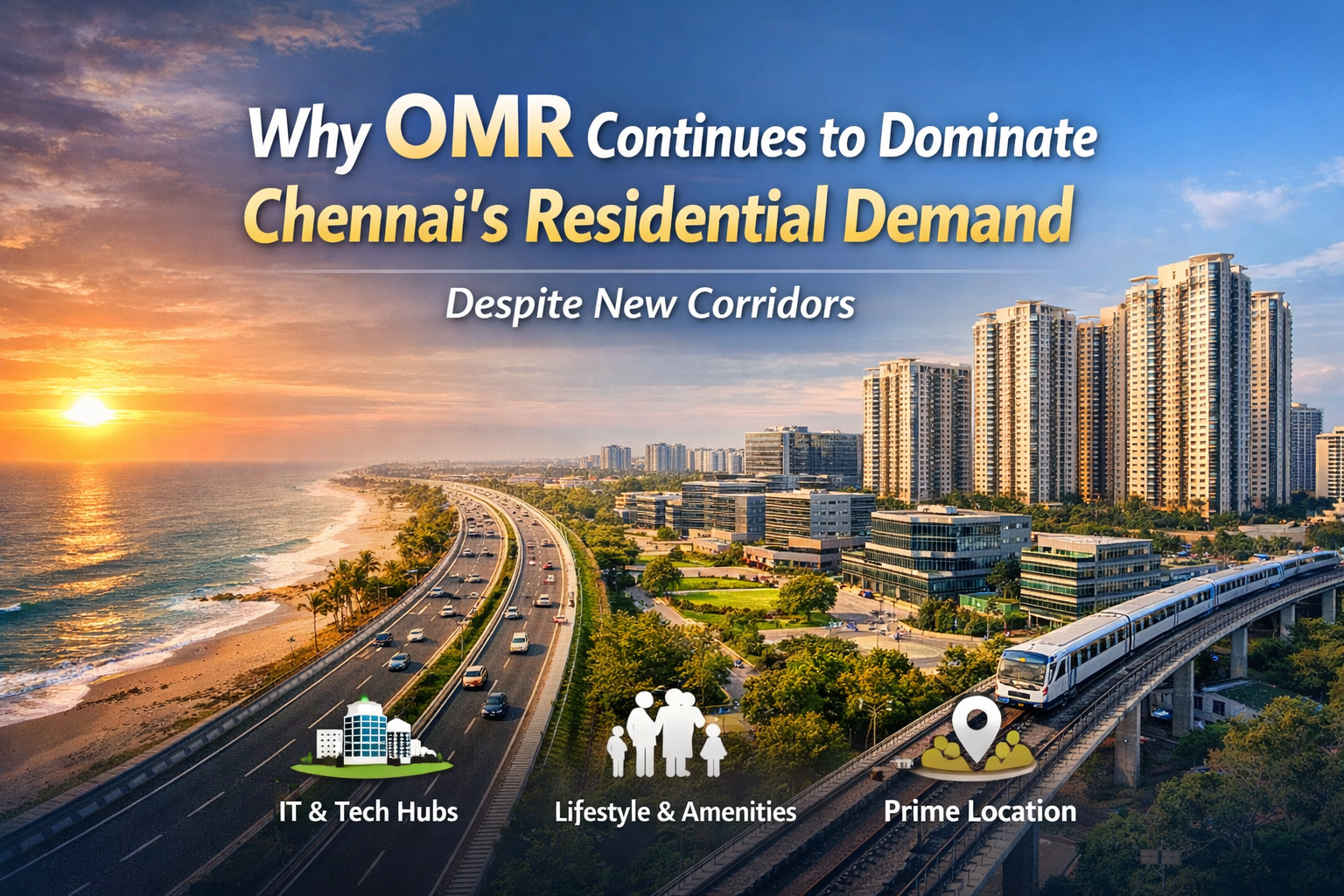
1. Employment Density Creates Non-Negotiable Housing Demand
Old Mahabalipuram Road is fundamentally different from other residential corridors because it is employment-first, not housing-first. The corridor hosts Chennai’s largest concentration of IT campuses, SEZs, and technology parks. This creates a daily, unavoidable housing requirement for a massive workforce. Unlike emerging corridors where housing is built in anticipation of future jobs, OMR’s residential demand is pulled by existing employment, making it structurally stronger and less dependent on market sentiment.
2. Live-Work Proximity Shapes Buyer Psychology
One of the most powerful yet underestimated reasons behind OMR’s dominance is commute economics. Chennai buyers strongly prioritize reduced travel time due to traffic congestion and limited cross-city mobility. Living close to OMR offices directly improves quality of life—less stress, predictable schedules, and lower transportation costs. New corridors may offer better pricing, but they often increase commute uncertainty, which most end users are unwilling to compromise on.
3. OMR Is a Fully Formed Residential Market, Not a Transition Zone
OMR has crossed the threshold from “developing” to mature residential market. This means:
- Clear residential zoning
- Predictable pricing behaviour
- Established neighbourhood identity
- Completed social infrastructure
New corridors are still in a transitional phase, where residential supply often runs ahead of social infrastructure. Buyers prefer OMR because it removes uncertainty—schools, hospitals, retail, and daily conveniences already exist and function.
4. End-User Dominance Creates Long-Term Stability
OMR’s buyer base is largely end users—professionals purchasing homes for self-use rather than short-term investors.
This matters because
- End users hold properties longer
- Distress sales are lower
- Price corrections are limited
- Absorption remains steady even during slowdowns
New corridors tend to attract higher speculative interest initially, which can lead to volatility. OMR’s user-driven demand makes it structurally resilient.
5. Rental Market Strength Acts as a Demand Safety Net
OMR’s rental market is not seasonal or cyclical—it is permanently active due to continuous hiring in the IT sector.
This creates a dual advantage:
- Investors feel secure due to low vacancy risk
- End users see strong resale and liquidity prospects
Even buyers who plan to self-occupy later often purchase earlier because they can rent the property immediately, a flexibility new corridors cannot consistently offer.
6. Infrastructure Development Has Followed Demand, Not Promises
OMR’s infrastructure growth—road expansions, flyovers, metro connectivity, and junction upgrades—has been demand-led.
This distinction is critical:
- Infrastructure already exists or is under execution
- Risk of project delays is lower
- Buyer confidence is higher
In contrast, newer corridors depend heavily on future infrastructure announcements. OMR benefits from execution credibility, built over years.
7. Price Acceptance Is Backed by Proven Performance
OMR is no longer a “cheap” market, but pricing here is accepted rather than resisted because:
- Employment is stable
- Rental income offsets ownership cost
- Appreciation has been historically consistent
Buyers perceive OMR pricing as justified by fundamentals, whereas low prices in new corridors are often viewed as compensating for risk and uncertainty.
8. Depth of Supply Meets Multiple Buyer Segments
OMR offers housing across:
- Affordable mid-segment apartments
- Premium gated communities
- Large integrated townships
- Villa developments
This depth allows buyers to upgrade within the same corridor, reducing migration to new areas. Emerging corridors typically serve only one or two segments, limiting long-term retention of residents.
9. Lifestyle Transformation Reinforces Emotional Attachment
OMR has evolved beyond a functional IT corridor into a lifestyle-driven residential belt.
Features such as:
- Walkable communities
- Recreational amenities
- Retail clusters
- Educational institutions
have created a sense of permanence and belonging. Buyers are not just choosing homes—they are choosing settled neighbourhoods, something new corridors take years to build.
10. Market Memory and Trust Play a Silent Role
OMR has a long market history of:
- Successful project deliveries
- Infrastructure follow-through
- Occupied communities
This builds collective buyer trust. Real estate decisions are heavily influenced by past performance, and OMR’s track record reduces perceived risk. New corridors, regardless of potential, must still earn this trust over time.
Conclusion
OMR continues to dominate Chennai’s residential demand not because new corridors lack potential, but because OMR already delivers what buyers prioritize most: jobs, certainty, liveability, rental security, and proven performance. Its dominance is not temporary or trend-driven; it is structural. As long as employment remains concentrated along this corridor, OMR will remain Chennai’s most dependable and demanded residential market—even as the city expands.