1. Location Fundamentals (Why the Area Exists as a Market)
Sholinganallur’s real estate importance comes from function, not lifestyle branding.
- It sits at the junction of Chennai’s IT employment belt and South Chennai’s residential expansion.
- It acts as a residential buffer zone for nearby IT hubs, absorbing daily housing demand from working professionals.
- Unlike peripheral suburbs, Sholinganallur did not grow speculatively—it grew because people needed to live close to work.
This functional relevance is why demand has remained consistent even during market slowdowns.
2. Evolution of the Real Estate Cycle (Past → Present)
Early Phase
- Initially undervalued land
- Entry of IT parks increased housing demand
- Prices were low, appreciation was fast
Growth Phase
- Large builders entered
- Gated communities became common
- Infrastructure struggled to keep pace
Current Phase (Important)
Sholinganallur is now a mature residential market:
- Prices are largely discovered
- Buyer expectations are realistic
- Appreciation is gradual, not explosive
- End-users dominate over investors
This maturity reduces volatility but also reduces speculative upside.
3. Price Behavior & What Actually Drives Value
Property prices in Sholinganallur are micro-location dependent.
Price drivers:
- Direct access to main roads
- Distance from OMR
- Quality of drainage & water supply
- Builder reputation and maintenance standards
- Gated community vs standalone apartment
What this means:
- Two properties 1 km apart can have vastly different long-term value
- Interior layouts without infrastructure see slower appreciation
- Premium pricing only sustains where convenience exists
Sholinganallur no longer rewards “any purchase anywhere.”
4. Rental Demand (One of the Strongest Pillars)
Rental demand is structurally strong, not cyclical.
- Driven by continuous inflow of IT professionals
- Demand exists for 1, 2, and 3 BHK units
- Gated communities near main roads rent faster
- Vacancies are typically short-term
However:
- Rental yields are moderate, not high
- Appreciation + rent together make returns attractive, not rent alone
This makes Sholinganallur suitable for long-term holding, not quick cash flow strategies.
5. Infrastructure Reality (Strengths & Weaknesses)
Strengths
- Established road connectivity
- Presence of hospitals, schools, offices, retail
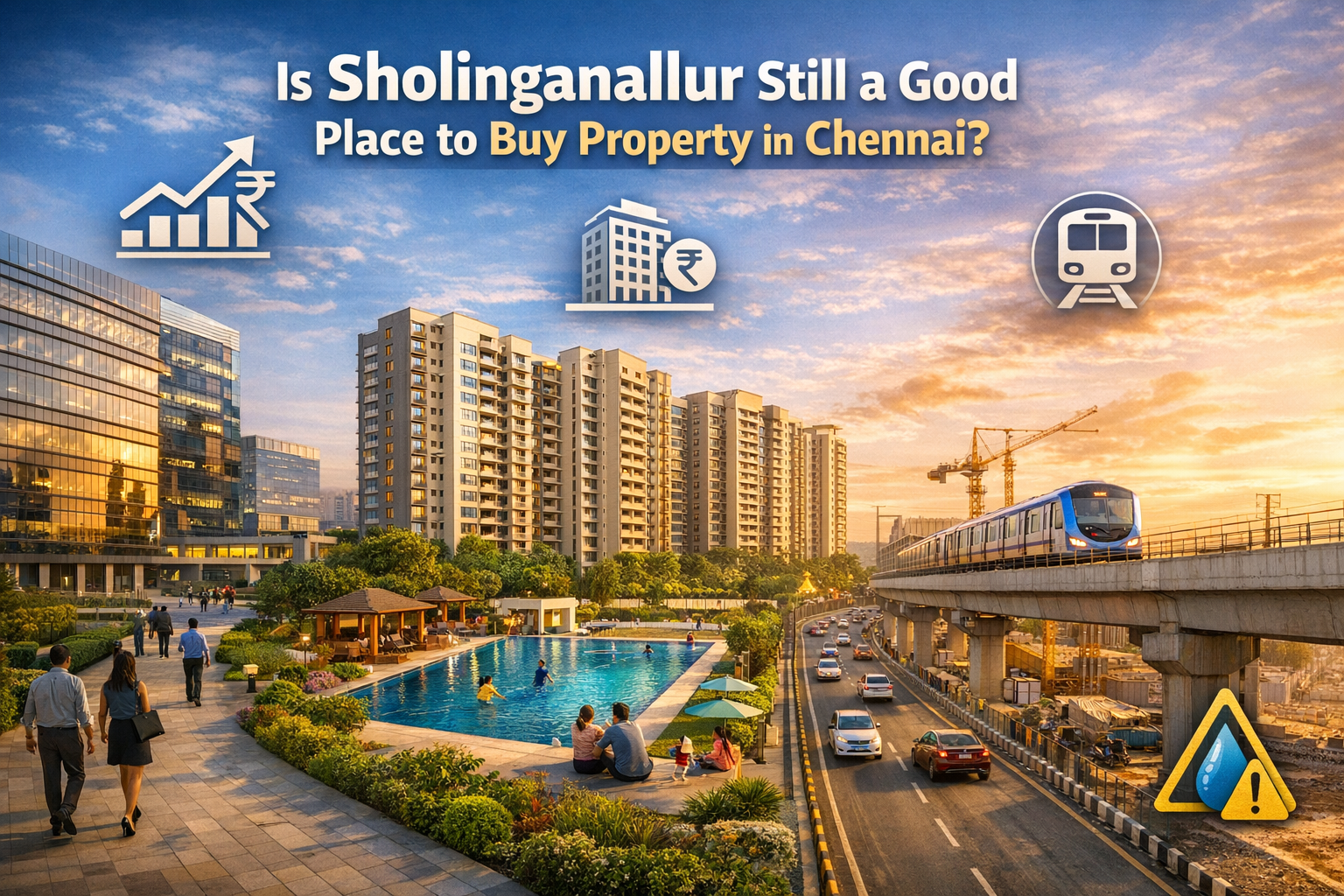
- Planned metro connectivity expected to ease future commuting
Weaknesses
- Traffic congestion during peak hours
- Infrastructure expansion lagging behind population growth
- Water dependency on private supply in some zones
- Construction activity causing short-term disruption
Key Insight:
Infrastructure quality is uneven, not uniformly poor or good.
6. Liveability Perspective (Day-to-Day Reality)
Sholinganallur is practical, not aspirational.
- Ideal for professionals working nearby
- Daily necessities are easily accessible
- Social and recreational life is limited compared to central Chennai
- Traffic stress is the biggest lifestyle drawback
Families prefer projects with internal amenities because the outside environment can feel congested.
7. Supply Risk & Oversaturation
Yes, supply is high — but not evenly absorbed.
- Well-planned projects continue to sell and rent well
- Poorly located or low-quality projects struggle
- Market penalizes weak construction and bad planning
This indicates a selective market, not a collapsing one.
8. Risk Assessment (What Can Go Wrong)
Real risks include:
- Buying in flood-prone or poorly drained pockets
- Choosing unknown builders to save cost
- Overpaying for “future promise” rather than existing infrastructure
- Assuming metro alone will fix all location issues
These are decision risks, not area risks.
9. Long-Term Outlook (5–10 Years)
Sholinganallur is expected to:
- Remain a key residential zone for the IT workforce
- See steady but moderate price appreciation
- Improve gradually with infrastructure upgrades
- Become more selective rather than expansive
It will not turn into a luxury destination, but it will remain relevant and occupied.
Conclusion
Sholinganallur is:
- Strong for end-users
- Stable for long-term investors
- Reliable for rental income
- Not ideal for short-term speculation
- Not uniform across all pockets