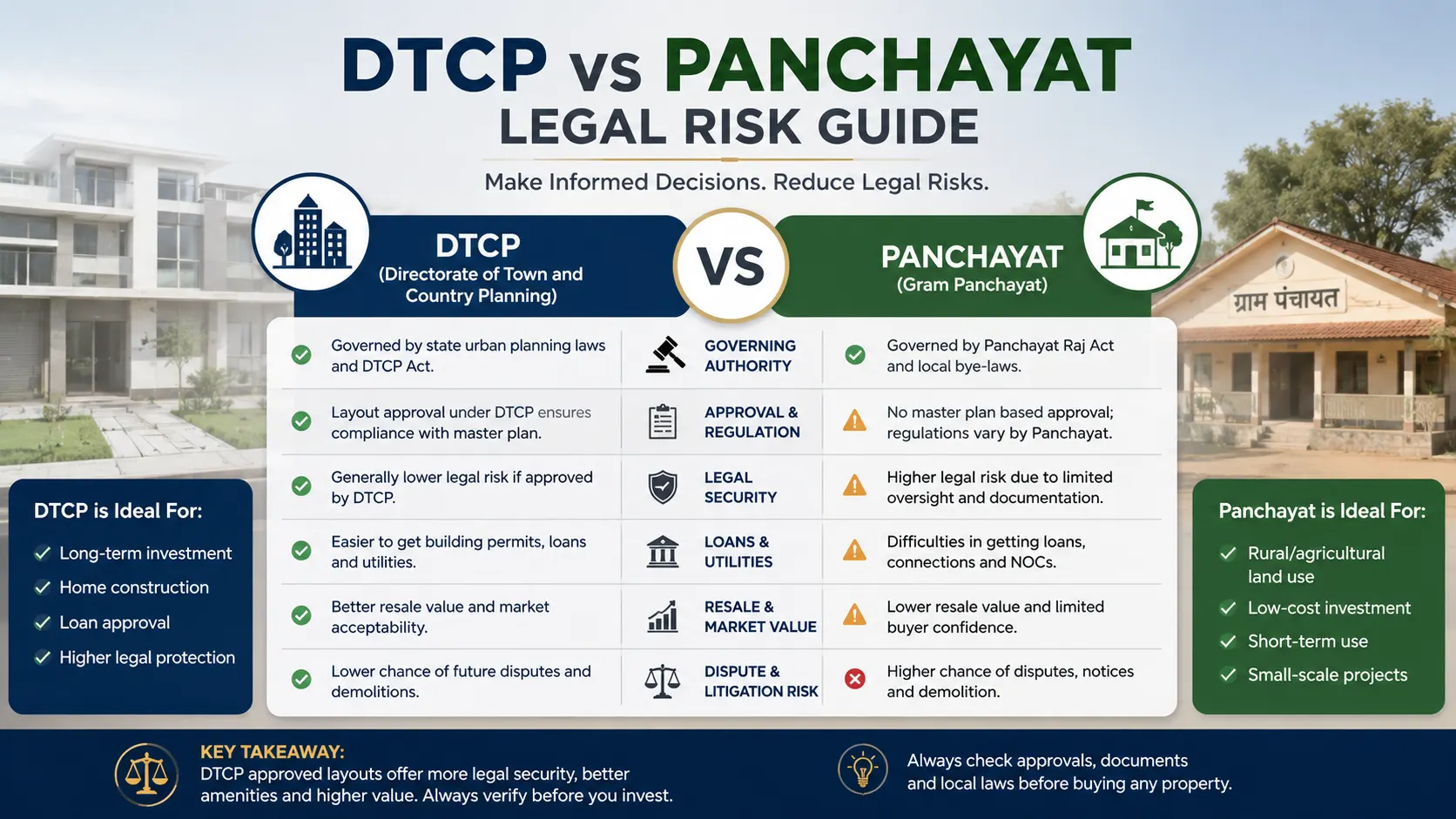
Buying land in India is not just about price and location—it is about legal approval. Thousands of buyers face losses every year because they don’t understand the difference between DTCP approval and Panchayat approval.
1. Understanding the Basics of Land Approval in India
In India, land ownership and land development are different.
- You can own land legally
- But you may not be allowed to develop or build on it
That permission comes only through planning authorities, not just local bodies.
2. What Is DTCP Approval? (Detailed Explanation)
The Directorate of Town and Country Planning (DTCP) is a state government statutory authority responsible for the planned development of towns, cities, and expanding urban areas.
What DTCP Approval Means
DTCP approval means:
- The land complies with the Master Plan/Development Plan
- The layout follows zoning regulations
- Roads, parks, and public spaces are legally allocated
- The land is approved for residential or commercial use
DTCP Approval Is Mandatory For
- Plot layouts
- Villa projects
- Gated communities
- Township developments
- Urban & peri-urban areas
3. DTCP Approval—Step-by-Step Legal Process
- Title Verification (30–40 years)
- Agricultural to Residential Land Conversion
- Zoning & Master Plan Compliance
- Layout Plan Preparation
- Infrastructure Planning (roads, drainage, OSR)
- Scrutiny by Planning Authority
- Issuance of DTCP Approval Number
- Layout Approval Notification
DTCP approval is permanent unless violated
It is recognized by courts, banks, and government bodies
4. What Is Panchayat Approval?
Gram Panchayat is a local village governing body formed under the Panchayati Raj system.
What Panchayat Approval Actually Is
Panchayat approval is not a planning approval. It is usually:
- Permission for individual house construction
- House number allocation
- Local tax assessment
What Panchayat Approval Cannot Do
- Cannot approve layouts
- Cannot change land use
- Cannot override master plans
- Cannot legalize urban development
5. The Biggest Misconception: Registration vs Approval
Term / Meaning
- Registration
- Records ownership
- Approval
- Legalizes development & construction
- A plot can be registered but illegal if not approved by DTCP.
6. Why Panchayat-Approved Plots Are Risky
Panchayat approvals are often misused by developers to:
- Avoid DTCP regulations
- Skip infrastructure costs
- Sell cheaper plots quickly
Major Legal Risks
- Layout declared unauthorized
- Construction labeled illegal
- Roads reclaimed by government
- Electricity & water disconnected
- Demolition notices issued
- No bank loan eligibility
7. Construction Stage—What Happens Later
DTCP-Approved Land
- Building plan approval granted
- Electricity, water, sewage sanctioned
- Completion certificate issued
- No demolition risk
Panchayat-Approved Land
- Construction may be stopped
- Building declared unauthorized
- Heavy penalties imposed
- Demolition risk exists even years later
8. Bank Loan & Financial Safety
DTCP Approval
- Accepted by nationalized & private banks
- Eligible for plot loan & home loan
- High buyer confidence
Panchayat Approval
- Mostly rejected by banks
- Only private financiers (high interest)
- Very poor resale demand
9. Government Action & Demolition Risk
DTCP Layouts
- Protected by statutory law
- Rarely face enforcement action
- Courts generally uphold approvals
Panchayat Layouts
- Frequently marked unauthorized
- Subject to demolition drives
- Regularization not guaranteed
10. Can Panchayat Approval Be Legalized Later?
Sometimes governments announce:
- Layout regularization schemes
- Unauthorized plot legalization programs
Reality
- High penalty costs
- Strict eligibility rules
- Long delays
- Many applications rejected
- Regularization is never a buyer’s legal right
11. Long-Term Ownership Risks 10–30 Years
DTCP-Approved Property
- Safe inheritance
- Easy mutation
- Clear title transfer
- Strong legal standing
Panchayat-Approved Property
- Title disputes
- Problems during sale
- Court cases common
- Risk increases with urban expansion
12. DTCP vs. Panchayat—End-to-End
- Land Conversion
- DTCP Approval: Agricultural land conversion to residential or non-agricultural use is mandatory and verified by the planning authority.
- Panchayat Approval: Land conversion is often skipped or improperly done, creating a weak legal foundation.
- Layout Legality
- DTCP Approval: The layout is fully legal and compliant with master plans, zoning laws, and development regulations.
- Panchayat Approval: Layout legality is weak because Panchayats do not have statutory authority to approve plotted developments.
- Registration Safety
- DTCP Approval: Plot registration is safe since the underlying layout is legally approved.
- Panchayat Approval: Registration is risky because it only records ownership and does not legalize the layout.
- Construction Approval
- DTCP Approval: Building plan approvals, utility connections, and completion certificates are easily granted.
- Panchayat Approval: Construction is often disputed later and may be declared unauthorized.
- Bank Loan Eligibility
- DTCP Approval: Eligible for plot loans, construction loans, and home loans from major banks.
- Panchayat Approval: Mostly rejected by banks; buyers rely on high-interest private lenders.
- Resale Ease
- DTCP Approval: High buyer confidence, strong demand, and smooth resale process.
- Panchayat Approval: Difficult resale due to legal doubts and lack of loan support.
- Demolition Risk
- DTCP Approval: Very low risk, as the project is protected by statutory planning approvals.
- Panchayat Approval: High risk of demolition or sealing if declared unauthorized.
- Long-Term Safety
- DTCP Approval: High long-term legal security, easy inheritance, and clear title transfer.
- Panchayat Approval: Low long-term safety with increasing legal risk over time.
Also Read: Importance of Building Approval and CMDA Norms in Chennai Real Estate
14. Conclusion
- DTCP approval = Legal protection + financial security
- Panchayat approval = Limited permission + high risk
- If you are buying land for living, building, or long-term investment, DTCP approval is non-negotiable.
Frequently Asked Questions
1. Is Panchayat approval legal in India?
Yes, but it is legally limited and does not replace DTCP approval where planning laws apply.
2. Can registered Panchayat land be demolished?
Yes. Registration does not protect against planning law violations.
3. Is DTCP approval mandatory everywhere?
Yes, in all areas covered by town planning and master plans.
4. Can DTCP approval be cancelled?
Only if obtained fraudulently or violated, and usually through legal process.
5. Why are Panchayat plots cheaper?
Because developers avoid:
- Infrastructure costs
- Planning compliance
- Legal approvals
6. Which approval is best for resale?
DTCP-approved properties have much higher resale value.
7. Is DTCP approval enough on its own?
It must be supported by:
- Clear title
- Land conversion
- Proper registration