1. What Is an Apartment Owners Association and Why It Is Necessary
An Apartment Owners Association is a collective legal body formed by the owners of flats in an apartment building or residential complex. It exists to manage, maintain, control, and protect the common interests of all apartment owners.
In Chennai, apartment living involves shared ownership of facilities such as lifts, staircases, corridors, water supply systems, sewage lines, electrical infrastructure, parking areas, security systems, and open spaces. Since no single owner can legally control these areas, the law recognizes an association as the only valid entity to administer them.
Without a registered association:
- Maintenance collection has no legal backing
- Service contracts cannot be enforced
- Disputes cannot be resolved collectively
- Builders often continue to control the property unfairly
Therefore, forming an association is not just advisable—it is practically essential for lawful apartment management.
2. Laws Governing Apartment Associations in Chennai
2.1 Tamil Nadu Apartment Ownership Act, 1994
This is the principal legislation governing apartment ownership in Tamil Nadu. It legally defines:
- Individual apartment ownership
- Undivided share (UDS) in common areas
- Rights and obligations of apartment owners
- Formation of an owners’ association
Under this act, common areas belong collectively to all apartment owners and cannot be sold, leased, or retained by the builder once apartments are sold.
2.2 Tamil Nadu Societies Registration Act, 1975
Most apartment associations in Chennai are registered under this Act because it provides a simple and effective legal framework.
Once registered with the Registrar of Societies, the association becomes a separate legal entity. This allows it to:
- Open bank accounts
- Collect maintenance compulsorily
- Enter contracts
- File legal cases
2.3 Real Estate (Regulation and Development) Act, 2016 (RERA)
RERA strengthens apartment owners’ rights by imposing legal duties on builders. It mandates that:
- The promoter must facilitate formation of an association
- Common areas must be handed over to the association
- Builders cannot indefinitely control maintenance
Failure to comply can attract penalties and legal action.
3. Legal Forms in Which an Association Can Be Registered
Apartment owners in Chennai can choose from three legal structures.
- The most widely used structure is a registered society under the Tamil Nadu Societies Registration Act. This form is flexible, recognized by all authorities, and suitable for most apartment complexes.
- Another option is forming an association under the Tamil Nadu Apartment Ownership Act itself. This structure emphasizes ownership rights but involves more procedural formalities.
- Cooperative housing societies are legally permitted but rarely chosen in Chennai due to extensive government control and regulatory complexity.
In practice, registering as a society is the preferred and recommended option.
4. Eligibility and Conditions for Forming an Association
To form an apartment owners association in Chennai:
- The building must be constructed and flats must be sold
- Members must be legal owners with registered sale deeds
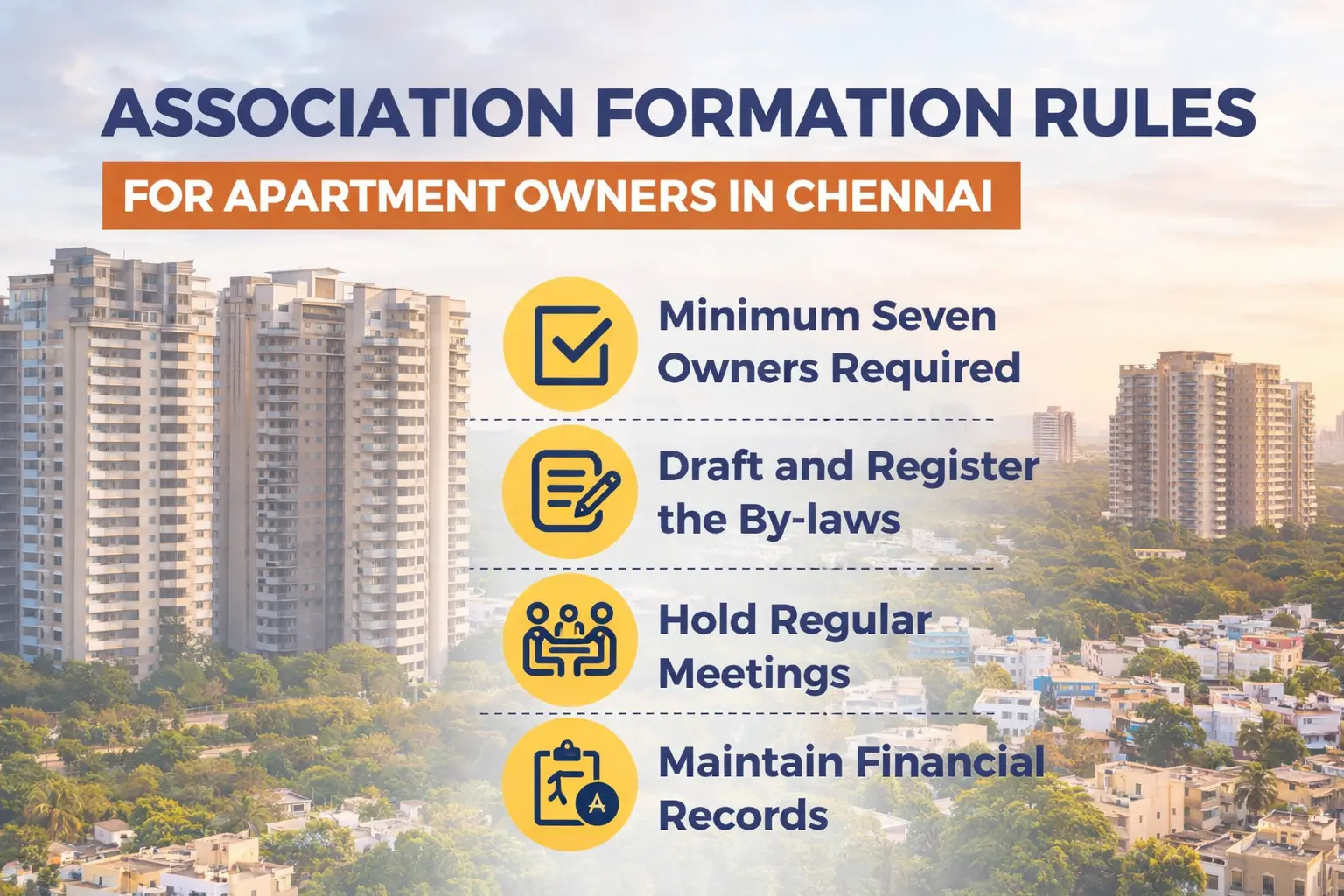
- A minimum of seven owners is usually required for society registration
- The building must have common areas shared by all owners
- Members must voluntarily agree to form the association
Occupancy Certificate is desirable but not always mandatory at the time of registration. However, it becomes important later for utilities, property tax, and legal compliance.
5. Step-by-Step Process of Association Formation
The process begins when apartment owners conduct a preliminary meeting to discuss formation. Interested owners then form an ad-hoc or provisional committee.
The committee selects a unique name for the association and drafts two key documents:
- Memorandum of Association, which defines the objectives
- Bye-laws, which govern internal administration
The bye-laws typically include:
- Membership rules
- Maintenance charges
- Voting rights
- Committee structure
- Meeting procedures
- Penalties for violations
Supporting documents such as sale deeds, identity proofs, address proofs, and meeting minutes are compiled and submitted to the Registrar of Societies.
After scrutiny and approval, the Registrar issues a Certificate of Registration. From this date, the association becomes a legal entity.
6. Role and Obligations of the Builder
The builder or promoter has a legal duty to:
- Facilitate formation of the association
- Hand over common areas and facilities
- Provide approved plans and documents
- Transfer maintenance responsibility
Builders often delay association formation to retain control over maintenance funds. Such actions are illegal under RERA and can be challenged legally by apartment owners. If the builder refuses to cooperate, owners can independently form the association and seek legal remedies.
7. Powers and Functions of a Registered Association
Once registered, the association has the legal authority to:
- Collect maintenance charges compulsorily
- Impose penalties for rule violations
- Appoint security, housekeeping, and maintenance vendors
- Maintain common funds and sinking funds
- Represent owners before courts and authorities
The association also has statutory duties:
- Maintain proper books of accounts
- Conduct Annual General Meetings
- File annual returns
- Act strictly according to its bye-laws
Misuse of funds or failure to follow procedures can result in legal consequences for office bearers.
8. Voting Rights and Decision-Making
Each apartment is entitled to one vote, regardless of:
- Number of owners
- Size of the flat
- Number of occupants
Joint owners must nominate one person to vote. Decisions are taken by majority, except where bye-laws require a special resolution.
9. Common Disputes and Legal Issues
Typical issues in Chennai apartments include:
- Builder refusing to hand over control
- Owners defaulting on maintenance
- Illegal parking allocation
- Encroachment of common areas
- Lack of transparency in accounts
A registered association is the only body legally empowered to resolve or litigate these disputes.
10. Consequences of Not Forming an Association
Failure to form a registered association can result in:
- No legal enforcement of maintenance payments
- Builder retaining indefinite control
- Difficulty in selling or mortgaging flats
- Inability to resolve disputes legally
In the long term, the absence of an association leads to administrative chaos and legal vulnerability.
Frequently Asked Questions (FAQs)
Is it compulsory to form an apartment association in Chennai?
While not forced immediately by law, it is practically mandatory under RERA and for lawful management.
Can the association be formed without the builder?
Yes. Owners can independently form and register an association.
Can tenants be members of the association?
No. Only legal apartment owners can be members.
Can maintenance be collected before registration?
Collection without registration has no legal enforceability.
Can the association disconnect water or electricity for non-payment?
Essential services cannot be disconnected, but legal recovery proceedings can be initiated.
Can one owner stop formation of an association?
No. As long as the minimum required owners agree, the association can be formed.
Can the association sue the builder?
Yes. A registered association has full legal standing.