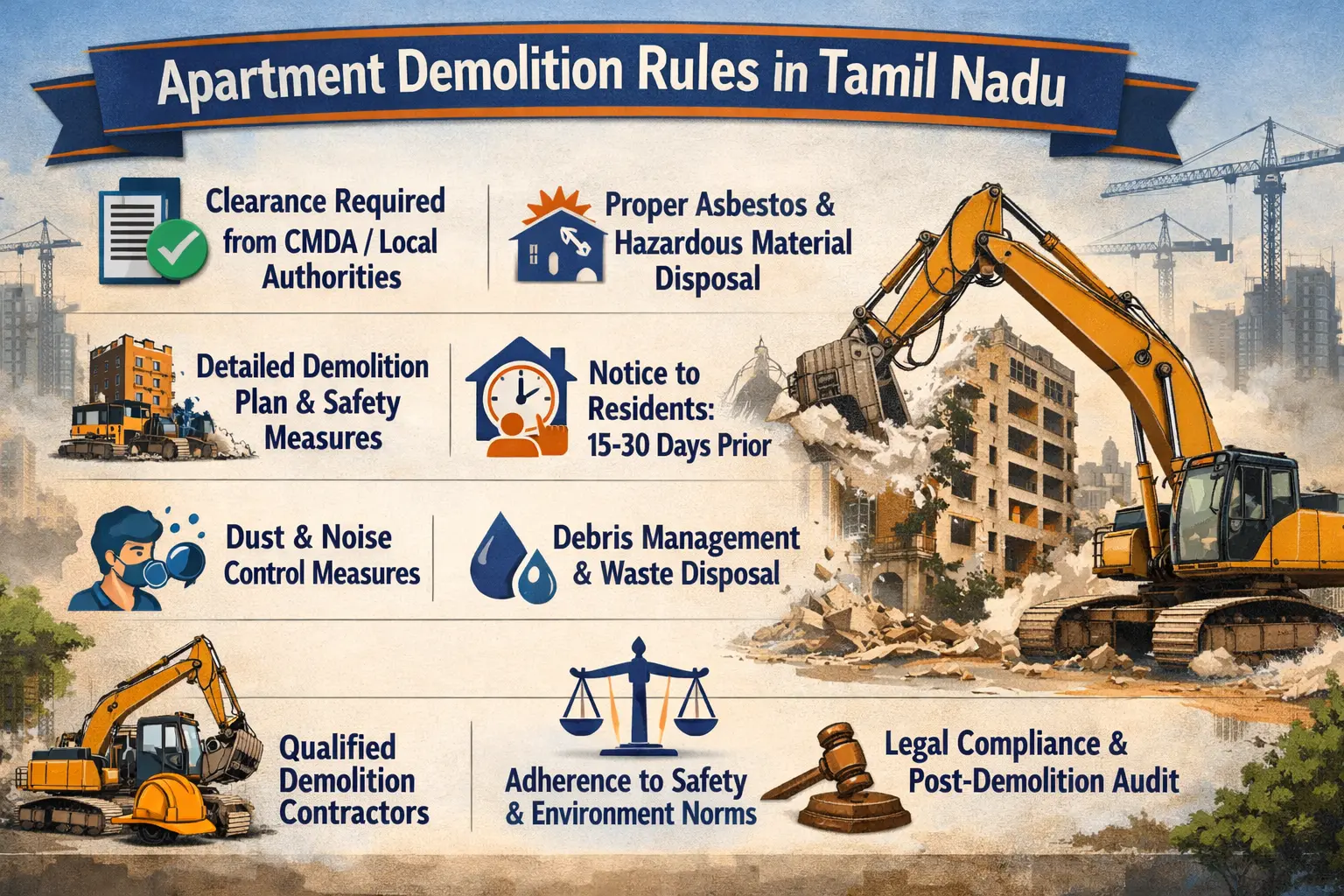
Apartment demolition in Tamil Nadu is a regulated legal process. It is governed by building laws, planning regulations, apartment ownership laws, and environmental rules to ensure public safety, owner protection, and orderly urban development. Demolition can be full or partial, but no demolition is allowed without prior approval from competent authorities.
1. Governing Laws and Regulations
Apartment demolition in Tamil Nadu is mainly controlled under the following legal framework:
- Tamil Nadu Combined Development and Building Rules, 2019
- Tamil Nadu Apartment Ownership Act
- Construction and Demolition Waste Management Rules, 2016
- Planning authorities such as
- Chennai Metropolitan Development Authority
- Local Municipal Corporations, Municipalities, and Town Panchayats
These laws collectively regulate permission, consent, safety, waste disposal, and redevelopment.
2. Meaning of Apartment Demolition
Apartment demolition refers to:
- Complete demolition of an entire apartment building, or
- Partial demolition, such as removal of:
- Floors
- Blocks or wings
- Staircases
- Load-bearing walls
- Structural portions
Both full and partial demolition require permission.
3. Requirement of Prior Permission
Mandatory Approval
No apartment or part of an apartment building can be demolished without written permission from the local authority.
Permission is required even if:
- The building is old
- The building is vacant
- The building is unsafe
- Demolition is for redevelopment
- Demolition is temporary
Unauthorized demolition is treated as a serious violation of law.
4. Authority Competent to Grant Permission
Depending on the location, permission must be obtained from:
- Municipal Corporation
- Municipality
- Town Panchayat
- Local Planning Authority
- Chennai Metropolitan Development Authority (for Chennai Metropolitan Area)
The authority may impose specific conditions before granting approval.
5. Consent of Apartment Owners
Joint Ownership Nature
Apartment buildings are jointly owned structures. Structural demolition affects all owners.
Mandatory Consent
- A registered apartment owners’ association is required.
- A minimum two-thirds consent of total apartment owners is mandatory for:
- Demolition
- Redevelopment
- Rebuilding
Nature of Consent
Consent must be:
- In writing
- Approved through a general body resolution
- Submitted to authorities along with application
An individual owner cannot unilaterally demolish any part of the apartment structure.
6. Demolition of Old, Dilapidated, or Unsafe Buildings
When an apartment building becomes:
- Structurally unstable
- Dangerous to occupants
- A threat to public safety
Then:
- The local authority may inspect the building
- The building may be declared unsafe
- Occupants may be directed to vacate
- Demolition may be ordered in public interest
Even in such cases:
- Due process must be followed
- Formal permission is mandatory
- Safety and waste rules still apply
7. Application Procedure for Demolition
The following are generally required:
- Demolition application
- Proof of land and building ownership
- Apartment association registration certificate
- Demolition plan
- Structural safety or stability report
- Owner consent documents
- Safety undertaking
- Waste disposal undertaking
- Payment of prescribed fees
Authorities may conduct site inspections before approval.
8. Safety Requirements During Demolition
Safety is a primary legal obligation during demolition.
Mandatory safety measures include:
- Barricading the site
- Display of warning boards
- Restricted entry to unauthorized persons
- Protection of adjacent buildings
- Prevention of debris falling on public roads
- Dust and noise control measures
- Use of safety gear by workers:
- Helmets
- Gloves
- Safety belts
- Goggles
Failure to follow safety norms can lead to immediate stoppage of work.
9. Construction and Demolition Waste Management
All demolition waste must be handled under:
- Construction and Demolition Waste Management Rules, 2016
Key obligations:
- No dumping on streets, drains, water bodies, or vacant land
- Waste must be transported to authorized facilities
- Debris must not obstruct traffic or public access
- Environmental pollution must be avoided
The owner or apartment association is fully responsible for compliance.
10. Illegal and Unauthorized Demolition
Demolition is illegal if:
- Done without permission
- Done without required owner consent
- Done beyond approved limits
- Done without safety precautions
- Done without waste disposal arrangements
Authorities may:
- Issue stop-work orders
- Impose penalties
- Order restoration or reconstruction
- Initiate legal proceedings
11. Post-Demolition Responsibilities
After demolition:
- Site must be cleared safely
- No public obstruction allowed
- The land must be secured
- Reconstruction requires fresh building plan approval
- New construction must comply with current building rules
Demolition permission does not automatically permit rebuilding.
Frequently Asked Questions (FAQs)
1. Is permission compulsory to demolish an apartment in Tamil Nadu?
Yes. Prior written approval from the competent authority is mandatory.
2. Can an apartment be demolished for redevelopment?
Yes, with at least two-thirds consent of owners and authority approval.
3. Can a single flat owner demolish their flat?
No. Structural demolition requires association approval and government permission.
4. What happens if the apartment is unsafe?
Authorities may declare it unsafe, order evacuation, and permit demolition after legal process.
5. Is partial demolition regulated?
Yes. Even removal of a single structural component requires permission.
6. What are the penalties for illegal demolition?
Fines, work stoppage, reconstruction orders, and legal action.
7. Who manages demolition waste?
The owner or apartment association is conducting the demolition.
8. Can demolition be stopped by authorities?
Yes. If safety, consent, or approval conditions are violated.
9. Is police assistance allowed during demolition?
Yes. Authorities may provide police assistance for eviction and safety enforcement.
10. Does demolition approval allow immediate rebuilding?
No. Reconstruction needs separate planning and building approval.